Elephant Rock in AlUla: The Complete Guide to Visiting, Sunset and Photography
Elephant Rock, Jabal AlFil in Arabic, is a natural sandstone formation in AlUla, eroded over millions of years by rain, wind and sand into the shape of an elephant resting its trunk on the ground; the official Experience AlUla guide puts its highest point at about 52 meters. It stands roughly a 20-minute drive northeast of AlUla Old Town and is reached by car along Highway 70, with free parking and a wooden path leading from the parking lot to the rock. The best time to visit is the hour before sunset through early evening, when the stone changes color and the rock is then illuminated after dark, with seating, fire pits and food and coffee outlets around it.
Editorial guide by the CHAPTERS TOUR team — AlUla
The answer in one line
Elephant Rock is a natural elephant-shaped sandstone formation about 20 minutes by car from AlUla Old Town; you reach it along Highway 70 with free parking, the best time to go is the hour before sunset into the evening when it is lit, and climbing it is not allowed.
What it is
A natural sandstone formation eroded over millions of years by rain, wind and sand; about 52 meters at its highest point according to the official guide.
Where
Northeast of AlUla Old Town, around a 20-minute drive.
How to get there
By car along Highway 70, with free parking and a wooden path from the parking lot to the rock, or as part of an organized tour.
Opening hours
The official guide lists the site as open daily from 4 p.m. to midnight; check it before you go, as hours can change.
Best time
Roughly an hour before sunset until after dark, when the stone changes color and the rock is then illuminated.
Rules
Climbing the rock is not allowed; photography is permitted.
For season, transport and the other landmarks, start with the complete AlUla guide.
Elephant Rock, Jabal AlFil in Arabic and simply “the elephant” to most locals, is AlUla's best-known rock formation. The official Experience AlUla guide describes it as a natural sandstone formation eroded over millions of years by rain, wind and sand into the form of a vast elephant resting its trunk on the ground, and puts its highest point at about 52 meters. That is far taller than photographs suggest; standing beneath it, you understand why Arabic calls it a mountain rather than a rock.
The geology, simply told: as with sandstone formations generally, the layers of AlUla's stone are not equally hard. Over millions of years, sand-laden wind and occasional rain wore away the softer layers faster than the harder ones, leaving the solid “body” suspended above the “trunk” that rests on the ground, with the gap opening between them. The carving has not finished; what you see today is one moment in a process still under way at a pace no visitor can perceive.
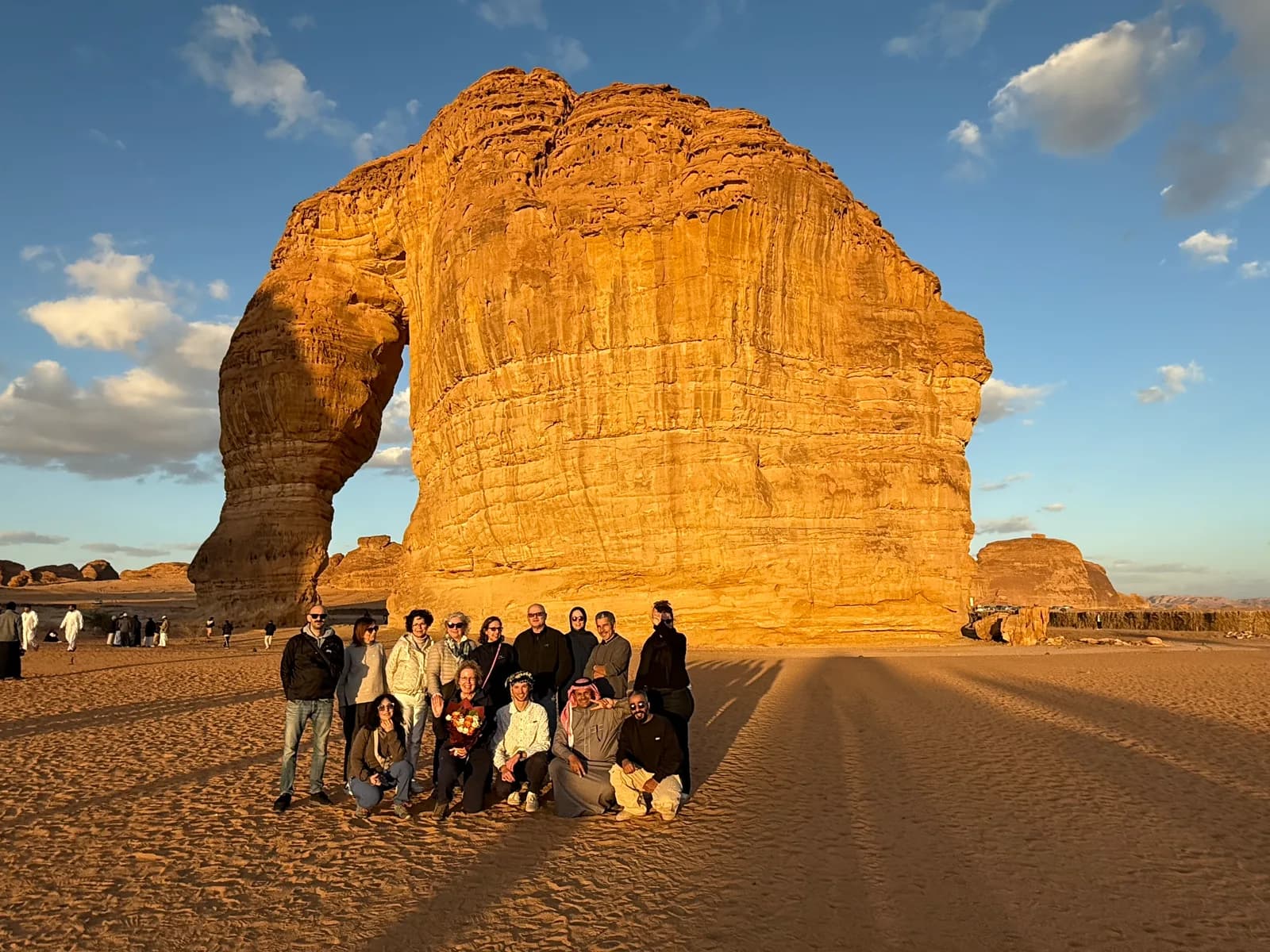
Elephant Rock in the last light of the day, with visitors for scale
Why does it draw more attention than AlUla's other rocks?
■The shape is unmistakable from a distance: it needs no imagination or particular angle to read as an elephant.
■It stands alone on an open sweep of sand, so you can walk around it and see it from every side.
■Late-afternoon light brings out the red of the sandstone, and the evening illumination then gives it an entirely different presence.
■Access is easy: parking close by and a wooden path, with no long walk and no climb.
The same sandstone that produced this shape also makes it fragile; that is why climbing the rock or interfering with its surface is not allowed. Photography is permitted, and respect is part of the visit.
02
Where is Elephant Rock and how do you get there?
Elephant Rock lies northeast of AlUla Old Town, and the official guide puts the drive at around 20 minutes. You can drive yourself along Highway 70, where parking is free, or arrive as part of an organized tour. From the parking lot, a wooden path leads through the entrance to the rock itself.
Direction
Northeast of AlUla Old Town.
Drive time
Around 20 minutes by car from Old Town, as estimated by the official guide.
Road
Highway 70; self-drive or as part of an organized tour.
Parking
Free, with a wooden path leading from the parking lot through the entrance to the rock.
01Check the sunset time for your date and aim to arrive at least an hour before it.
02Allow about 20 minutes' driving from Old Town, and more if you are staying at the far end of AlUla or the evening is busy.
03Park in the free lot and follow the wooden path to the rock; it leads straight there and suits most visitors.
04If you rely on a driver or a tour, agree on the return time in advance; the place tempts you to stay on after dinner.
We give no distance in kilometers because the official guide expresses it only as driving time; the real figure varies with your starting point and evening traffic.
If you are still choosing where to stay, being close to your evening anchor saves you a drive in the dark.
The best time to visit Elephant Rock: time of day and time of year
The short answer: late afternoon, sunset and early evening. The official guide recommends heading there as evening approaches and notes that the rock is illuminated as dusk descends while music plays gently in the background. The same guide calls sunrise and sunset the prime times for all of AlUla's rock formations, but the site's published opening hours begin in the afternoon, which makes sunset the practical choice.
Time of day
Light
Crowds
Best for
An hour before sunset
Warm side light that brings out the red of the stone and the texture of its surface
Moderate and building
Photography and walking around the rock
Sunset
A fast shift from gold to pink to blue
Usually the busiest
The classic shot and settling in
Early evening
The site lighting takes over while the sky is still blue
High, then easing gradually
Sitting by the fire pits; families
Late evening
Site lighting alone, with stars overhead away from the lights
The quietest
Calm, conversation and stargazing
And across the year? AlUla's mild season generally runs from autumn to spring, and summer stays hot even in the evening. Month-by-month detail on weather and who each period suits is in our guide to the best time to visit AlUla.
The crowd levels in the table are an editorial estimate from experience, not official data; weekends and seasonal festivals change them.
Elephant Rock is not an arrive-photograph-leave stop; the site is arranged around sitting down. The official guide describes it as welcoming visitors through the afternoon and evening, and lists seating near the rock, fire pits for visitors to gather around, and food and coffee outlets that need no advance booking.
■Walk the wooden path, then circle the rock; the elephant changes with every angle.
■Take a seat and watch the light move across the stone until the illumination comes on.
■Have a light dinner or a coffee from the on-site outlets, and gather around a fire pit on winter nights.
■Look up once it is fully dark; the sky here is clearer than in the town center.
■Photograph freely, since photography is permitted, but do not climb the rock or try to reach its top.
What does the official guide list on site?
Access and path
Free parking and a wooden path from the parking lot through the entrance to the rock.
Seating
Seating near the rock and fire pits for gathering in the evening.
Food and coffee
Burger and coffee outlets and a shisha cafe, open through the afternoon and evening and welcoming visitors without a booking.
Lighting
The rock is illuminated as dusk descends, with gentle music in the background.
Outlet names and hours change from season to season; we describe the type of service the official guide lists rather than specific names, and recommend checking the site's page before relying on a particular meal or cafe.
05
Elephant Rock with children and older guests
This is one of the easiest AlUla landmarks for a multigenerational group: no long walk and no climb, with parking close by, a wooden path and seating that suit anyone who tires quickly or is pushing a stroller, with a few cautions. The hike that sets off from the Elephant Rock area to Jar Rock is described by the official guide as not recommended for children; keep the little ones in the seating area.
■Off the wooden path the sand is soft; strollers and wheelchairs move far more easily on the path than on the sand.
■Temperatures drop quickly after sunset in the winter months; bring an extra layer for children and older guests, and the fire pits help.
■The evening lighting is there, but the site is wide open; keep children within sight after dark.
■The Jar Rock hike that starts here is not recommended for children, according to the official guide.
■Climbing the rock is not allowed; explain this to children before you arrive, not on the spot.
■Water, even on a cold evening.
■A warm layer for everyone in the winter season.
■A small flashlight or a charged phone for the walk back to the parking lot.
■Evening medication for older guests.
■Wet wipes for sand and food.
Age-by-age detail, and what to wear and carry, are in two dedicated guides.
Photographing Elephant Rock: angles that work and common mistakes
Elephant Rock is among the most photographed landmarks in Saudi Arabia, which means the “standard” shot already exists in thousands of copies. Three things make the difference: timing, scale and the patience to wait for the transformation.
■The classic shot: from the side where the trunk and the gap beneath it read clearly, half an hour before sunset, with one small figure in the frame to show the rock's true size.
■The scale shot: step well back until the sand and the whole sky enter the frame; the rock does not need to fill the picture to command it.
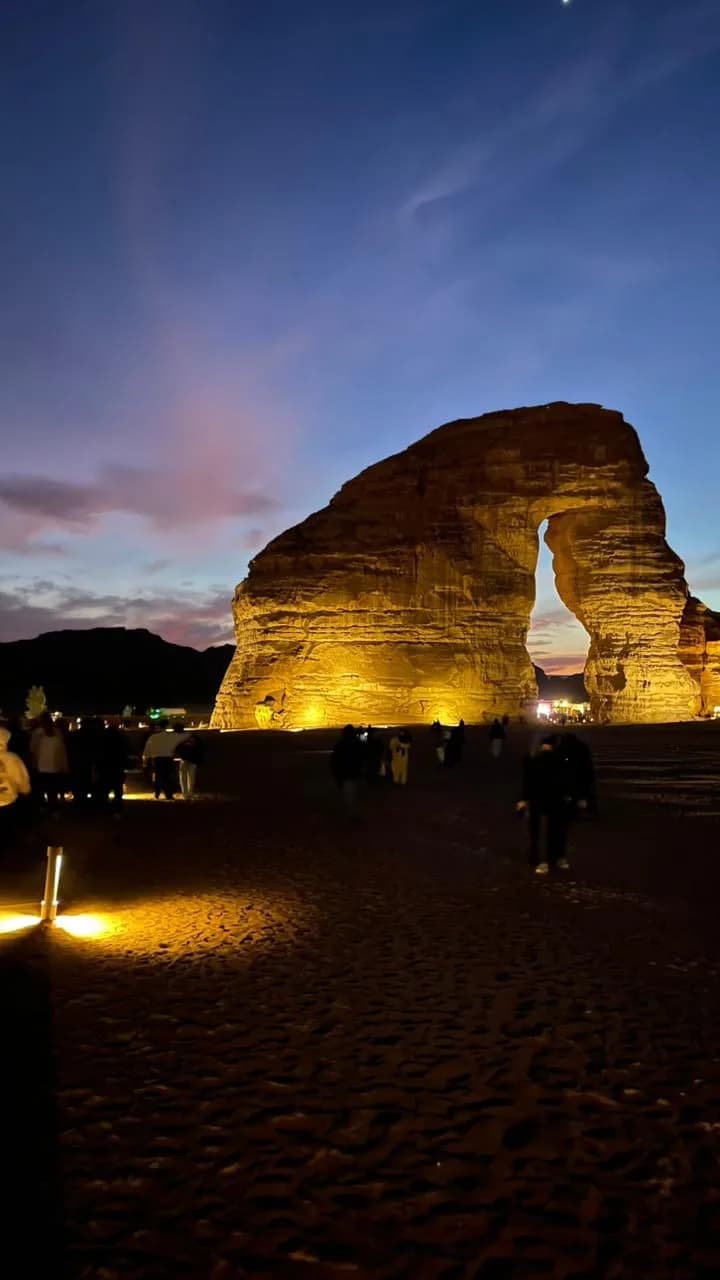
■The blue-hour shot: ten to twenty minutes after sunset, when the site lighting is on and the sky is still deep blue, the best balance between the lit rock and the sky.
■The night shot: a starry sky above an illuminated rock needs a tripod and a long exposure, and works best late in the evening when the crowd thins.
The blue-hour shot: the rock lit, the sky still blue
Mistakes that keep recurring
■Arriving at sunset rather than before it: the finest transformation begins before the sun goes and ends minutes after.
■Shooting only from eye level: lower the camera close to the sand and the rock looks taller and heavier.
■Flash at night: it will never reach the rock and it spoils the scene for everyone around you. Rely on the site lighting and a long exposure.
■Climbing for a “different” angle: it is not allowed, and it endangers both the rock and the photographer.
■Flying a drone without permission: do not assume it is allowed; check the regulations before your trip.
A modern phone is enough for most of these shots; what no camera can replace is arriving at the right time and staying until the transformation is complete.
07
How to combine Elephant Rock with Hegra and Maraya in one day
These three are among AlUla's best-known stops, and they fit into one day because each has its natural hour: Hegra (Mada'in Salih) in the morning, Maraya during the day or late afternoon, and Elephant Rock for sunset and the evening. Hegra is Saudi Arabia's first UNESCO World Heritage Site and the official guide strongly recommends booking its tour ahead; Maraya is a mirror-clad building in Ashar Valley about a 20-minute drive from the center of AlUla, and since, according to the official guide, there is currently no access to its interior for passing visitors outside published events and tours, a visit is a short photo stop from the outside.
01Morning: the Hegra tour with a pre-booked slot; this is the stop the rest of the day is built around.
02Midday: lunch and rest; do not schedule an exposed stop under the midday sun.
03Late afternoon: a Maraya stop from the outside for photographs, or an event there if one is published for your date.
04An hour before sunset: arrive at Elephant Rock and walk around the rock before the light turns.
05Evening: sit, have a light dinner from the on-site outlets, then leave at the agreed time.
Stop
Natural hour
What needs booking
Comfortable duration
Hegra
Morning
A pre-booked tour slot (the official guide's recommendation)
The whole morning
Maraya
Daytime or late afternoon
A published event or tour to go inside; photographing the exterior needs none
A short stop
Elephant Rock
An hour before sunset into the evening
No booking for the food outlets according to the official guide; check the site page for access
From the sunset hour until after dinner
This is a planning framework, not a product for sale; Hegra slots and Maraya events must be checked at booking. If you have two full days, our 48-hour AlUla itinerary spreads the stops at a calmer pace.
CHAPTERS journeys to AlUla include transport, a guide and accommodation, and they typically include a sunset stop at Elephant Rock on one evening of the trip. What we add is not access to the rock, which any visitor can reach, but timing and sequence:
■Arriving before the light turns, not after, because the guide knows the actual sunset time on your date and allows for the drive from your accommodation.
■Arranging the day so Elephant Rock is its closing chapter, not a stop squeezed between two sites.
■Someone else drives, so you stay seated until late in the evening without calculating the way back.
■Context from the guide: the geology, the names of the neighboring rocks, and where to stand for the best angle.
■A fallback if the weather changes or the site closes for an event, decided with you, not for you.
Browse the published journeys, or design a private journey if you want an evening arranged for your own group alone. For practical questions, see the FAQ.
A natural sandstone formation in AlUla, eroded over millions of years by rain, wind and sand into the shape of an elephant resting its trunk on the ground. The official Experience AlUla guide puts its highest point at about 52 meters. In Arabic it is Jabal AlFil, “the elephant mountain.”
How far is Elephant Rock from AlUla?
Around a 20-minute drive northeast of AlUla Old Town, along Highway 70, according to the official guide. The actual time depends on where you are staying and on evening traffic.
Is Elephant Rock free to visit?
The official guide lists no ticket for the site and states that parking is free, but it does not explicitly say that entry is free. Check the Elephant Rock page on Experience AlUla before your visit, as arrangements can change during festival seasons.
What is the best time to visit Elephant Rock?
Roughly an hour before sunset through early evening: the sandstone changes color in the late light and the rock is then illuminated as dusk descends. The official guide lists the site as open daily from 4 p.m. to midnight.
Can you climb Elephant Rock?
No. The official guide states that climbing is not allowed because the rock is a beloved feature of AlUla that must be protected. Photography from the ground is permitted.
Are there cafes or food at Elephant Rock?
Yes. The official guide lists burger and coffee outlets and a shisha cafe, open through the afternoon and evening and welcoming visitors without a booking, alongside seating and fire pits. Outlets change between seasons, so check the official page before counting on one.
Is Elephant Rock lit at night?
Yes. The official guide notes that the rock is illuminated as dusk descends while music plays gently in the background, which makes early evening one of the best times to visit and photograph it.
How long do I need at Elephant Rock?
One hour is enough to walk around the rock and take photographs, but the real value lies in staying from before sunset until the lighting comes on, around two hours with a coffee or a light dinner. This is an editorial estimate, not an official timing.
Make sunset at Elephant Rock the close of your day, not a passing stop
CHAPTERS journeys to AlUla include transport, a guide and accommodation, and typically include an evening at Elephant Rock at the right hour. Browse the published journeys, or share your dates and your guests' ages so we can design a private journey around what you do not want to miss.